
The Australian Online Seller’s Complete Guide to Ecommerce Accounting
Running an online store is exciting. The orders come in, the stock moves, and you’re shipping product across the country. Sometimes the world. But somewhere between your Shopify dashboard and your bank statement, the numbers get messy.
Ecommerce accounting isn’t like regular small business accounting. You’re dealing with multi-channel sales, marketplace fees, inventory spread across locations, GST on international transactions, and payment processors that never quite match your bank balance.
This guide is for Australian online sellers who want to understand what’s actually involved: from GST and BAS to inventory valuation, software, and knowing when to call in a specialist. Whether you’re on Shopify, Amazon, WooCommerce, or eBay, getting the accounting right from the start protects your margins and keeps the ATO happy.
What is ecommerce accounting?
Ecommerce accounting is the process of recording, categorising, and reporting the financial transactions of an online business. That includes revenue from platforms like Shopify, Amazon, WooCommerce, and eBay; the cost of goods sold and fulfilment; GST and BAS; cash flow; and profit reporting.
Unlike traditional retail, ecommerce generates data across multiple platforms at once, each with different fee structures, payout schedules, payment gateways and reporting formats. You need someone who understands all of it, not just the bank statements.
Why ecommerce businesses need a specialist accountant
Most general accountants are competent. But if they’ve never dealt with Amazon FBA or a Shopify store, they’ll miss things that cost you money.
Here’s what separates ecommerce from everything else:
- Amazon settlements, Shopify payouts, eBay payments, and WooCommerce orders all arrive in different formats at different times.
- Amazon referral fees, FBA storage charges, Shopify transaction fees, Shopify platform fees and advertising costs all need to be captured separately, not lumped together.
- Stock you own but Amazon holds in an FBA warehouse is still your asset. It goes on your balance sheet.
- Stripe, PayPal, Afterpay, Zippay and Square hold funds, take fees, and release net deposits. If you record only the deposit, you’re undercounting revenue and missing deductible expenses.
- Selling into the US or UK brings currency conversion into the mix, with its own accounting, GST/VAT and tax implications.
None of this is unusual for online sellers — it’s just Tuesday. Get it wrong and you end up with inaccurate BAS lodgements, understated cost of goods sold, and profit figures that don’t reflect reality.
That’s why a lot of growing businesses move to dedicated ecommerce accounting services rather than sticking with a generalist.
Australian GST for online sellers
When do you need to register for GST?
Once your annual turnover hits $75,000, GST registration is compulsory. Online or bricks-and-mortar, it doesn’t matter. For a fast-growing store, that number can arrive faster than you’d expect.
Once you’re registered, you:
- Charge 10% GST on taxable domestic sales
- Lodge a Business Activity Statement, usually quarterly
- Claim GST credits on eligible business expenses
Are exports GST-free?
Usually. Goods physically shipped from Australia to an overseas customer are generally GST-free under Australian tax law.
Digital products are a different story. The ATO’s rules on digital services apply depending on what you’re selling and who you’re selling it to. If you’re selling software, courses, or subscriptions to overseas customers, check the ATO’s guidance or ask your accountant before assuming GST-free applies.
More complications arises if your shipping/fulfillment models also varies between Direct to consumer (DTC), Overseas 3PL Fulfilment, Cross border Ecommerce, dropshipping, Fulfilment by Amazon *FBA) etc. All of these fulfillment models have their own GST treatment methodology that brings about further complexity
Your BAS obligations
Your BAS captures GST on sales minus GST on expenses, plus PAYG withholding if you have employees. Most businesses lodge quarterly; higher-turnover businesses lodge monthly.
Getting this right depends on having clean, up-to-date records. Xero connected to A2X for Amazon and Shopify pulls transaction data automatically, which makes BAS preparation much faster and less prone to error.
Inventory accounting: the area most sellers get wrong
Inventory is often the largest asset on an ecommerce balance sheet. Get it wrong and you don’t just have a tax problem — you have a false read on how profitable the business actually is.
Cost of goods sold (COGS)
COGS covers the direct cost of what you sell: purchase price, inward freight, import duties, packaging. Subtract it from revenue and you get gross profit.
The mistake a lot of sellers make is treating stock purchases as an expense when they buy. This is called cash accounting. It may be easier to manage cash accounting for smaller businesses, but if you really want to evaluate your business performance, you should opt for accrual accounting. In accrual accounting. stock is an expense only when it’s sold. Spending $10,000 on inventory in June doesn’t create a $10,000 deduction in June — it creates an asset that converts to an expense as each unit moves.
Choosing an inventory valuation method
Method | How it works | Best for |
|---|---|---|
FIFO (First In, First Out) | Oldest stock assumed sold first | Fashion, perishables, seasonal products |
Weighted Average Cost | Average cost per unit across all batches | Commodity products where batches are interchangeable |
The ATO doesn’t mandate a method, but you must apply it consistently. Switching requires ATO approval. Don’t do it without advice.
Stock write-downs
Damaged, slow-moving, or dead stock can be written down to its net realisable value — a legitimate tax deduction, but it requires documentation. A year-end stocktake and written evidence of impairment are the minimum.
Manual vs cloud accounting: which should you use?
Feature | Spreadsheets | Cloud accounting (Xero + A2X) |
|---|---|---|
Bank reconciliation | Manual, error-prone | Automated bank feeds |
GST tracking | Manual entry | Automatic classification |
BAS preparation | Time-consuming | Near-automated |
Amazon/Shopify data | Manual import | A2X pulls and maps automatically |
Real-time reporting | No | Yes |
Accountant access | Files emailed back and forth | Live shared access |
Scalability | Breaks down above moderate volume | Scales with the business |
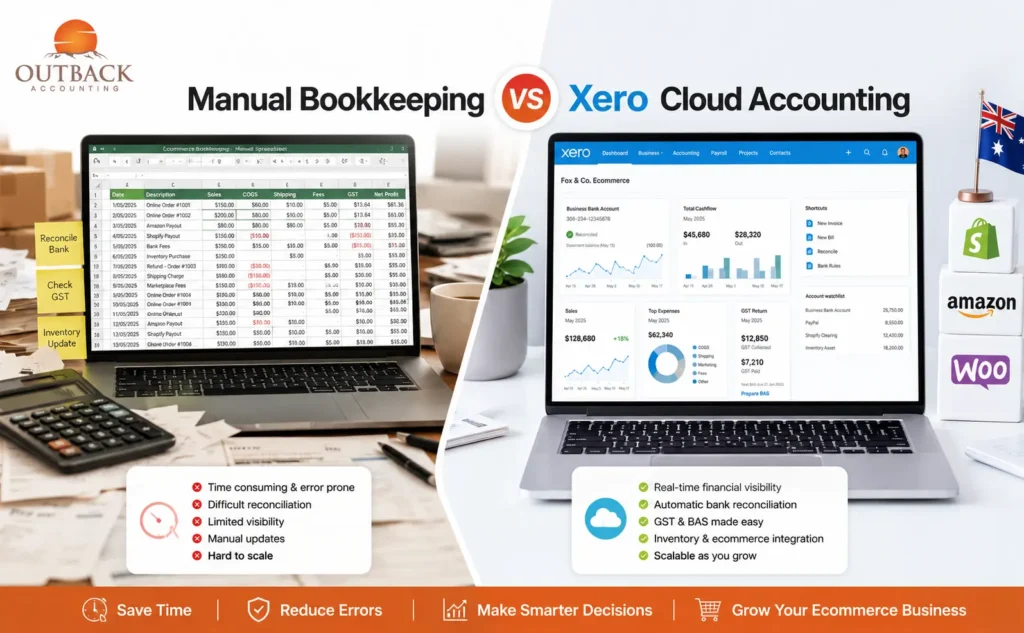
For ecommerce businesses doing any real volume, Xero is the standard. Bank feeds, Shopify integration, and A2X for Amazon settlements. MYOB and QuickBooks work too, but most accountants who specialise in ecommerce are in Xero.
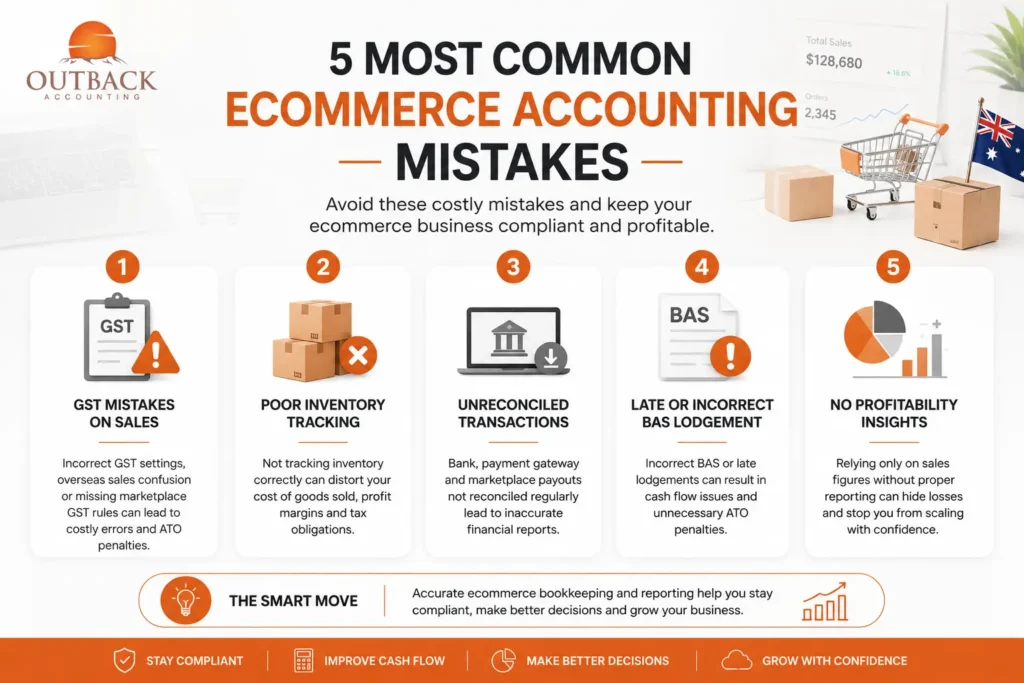
The five most common ecommerce accounting mistakes
- Mixing personal and business financesOpen a dedicated business bank account before you do anything else. Without it, every reconciliation is a guessing game.
- Treating revenue as profitShopify showing $120,000 in sales doesn’t mean you made $120,000. Subtract COGS, platform fees, ads, fulfilment, subscriptions, and GST. Then see what’s left.
- Incorrect GST treatment on Ads Spend. Google and meta ads spent is one of the major cost driver for an ecomm business. Google ads spent is usually GST applicable and Facebooks ads doesnt have GST on it (if ABN number is provided). ADs spent make up anywhere from 15% -40% of expense to turnover ratio. If you get gst treatment wrong on major expense, that will materially impact your profitability and the BAS reporting to ATO.
- Ignoring marketplace feesAmazon’s referral fees, FBA charges, costs need to be recorded properly. Miss them and your margin calculations are wrong — and so is your tax position.
- Skipping payment processor reconciliationStripe and PayPal net down their payouts after fees. Record only the deposit and you’re missing out on recording payment gateways fees in your accounts and calculating incorrect gst.
- Leaving BAS to the last weekQuarterly BAS needs quarterly records. If you haven’t touched the books in three months, the final week before lodgement is not the time to start catching up.
Working with a team experienced in accounting for online businesses prevents most of these before they become ATO issues.
Cash flow management for online sellers
Profitable businesses run out of cash. It happens in ecommerce more often than people expect, usually for predictable reasons:
- Stock builds ahead of Christmas or EOFY lock up cash weeks before the revenue arrives
- Amazon pays fortnightly, not when the sale happens
- Stripe and PayPal sometimes hold funds on fast-growing or newer accounts
- GST collected now gets remitted next quarter
- Deferring GST at import stage could save you cash by delaying payment of GST at import stage using Deferred GST Scheme
A rolling 90-day forecast lets you see these pinch points before they bite. Your accountant should be helping you maintain one year-round, not just appearing at tax time.
Multi-channel selling: managing Shopify, Amazon, eBay, and WooCommerce
One platform is manageable. Add a second or third and the complexity compounds quickly. Amazon settles fortnightly. Shopify pays daily. eBay does its own thing. None of them match your bank statement one-to-one.
The fix is a structured Xero chart of accounts with clear mapping rules for each platform. A2X handles that for Amazon and Shopify. One clean set of books across all channels — instead of four spreadsheets nobody fully trusts.
If you’re across multiple platforms and the numbers are becoming unmanageable, a specialist ecommerce accountant can usually straighten out the setup without needing to start from scratch.
How to choose an ecommerce accountant
Step 1: Ask about your specific platforms Not “do you work with ecommerce?” Ask whether they’ve dealt with Amazon FBA, Shopify, and A2X in particular. General ecommerce experience isn’t the same as handling Amazon settlements daily.
Step 2: Check their Xero credentials Xero Gold or Platinum Partner is a reasonable baseline. It means they have the expertise using the platform.
Step 3: Understand how they handle your BAS Is BAS preparation automated from Xero data, or are they doing it manually? The answer affects accuracy and turnaround time.
Step 4: Get clear on pricing Fixed monthly fees work better for ecommerce than hourly billing. You don’t want a surprise invoice every time something complicated happens.
Step 5: See how they actually communicate An accountant who contacts you once a year after EOFY isn’t much use. Ask how they handle questions during the year and what kind of response time you can expect.
Step 6: Confirm ATO registration Anyone providing tax advice in Australia must be registered with the Tax Practitioners Board. You can check at tpb.gov.au before committing.
Key takeaways
- Ecommerce accounting has more moving parts than standard small business accounting. Multi-channel data, inventory valuation, marketplace fees, and GST compliance all need specialist handling.
- GST registration is compulsory at $75,000 turnover. Lodge your BAS on time.
- Stock isn’t an expense when you buy it — it becomes Cost of Goods Sold when you sell it. Use accrual accounting for cost of goods sold instead of cash accounting. A lot of sellers get this wrong for years before anyone notices.
- Xero and A2X is the setup most Australian ecommerce businesses end up on.
- The common mistakes are all avoidable: separate finances, GST on meta and google ads, track fees properly, reconcile regularly, don’t leave BAS prep to the last minute.
- Outsource when bookkeeping is taking more than four hours a week or you’re no longer confident the numbers are right.
- Platform experience, Xero certification, and TPB registration are the three things to check before hiring an accountant.
Frequently asked questions
What is ecommerce accounting? It’s the recording and reporting of financial activity for an online business: sales from Shopify, Amazon, WooCommerce, eBay and similar platforms; inventory; GST and BAS; marketplace fees; and profit. It’s more involved than regular small business accounting because of multi-channel data and inventory complexity.
Do I need to register for GST as an online seller? Yes, once annual turnover exceeds $75,000. After that, you charge 10% GST on taxable domestic sales and lodge a BAS, typically quarterly.
Are goods I export overseas subject to GST? Not usually. Goods physically shipped from Australia are generally GST-free. Digital products are handled differently depending on what you’re selling and where the customer is. Check with a registered tax agent if you’re selling software, courses, or subscriptions overseas.
How is Amazon FBA treated for Australian tax purposes? FBA inventory is your asset, even while Amazon physically holds it. It belongs on your balance sheet. Amazon settlements are net amounts after fees and refunds, not gross revenue. A2X maps those settlements correctly into Xero so you’re not trying to reverse-engineer them yourself.
What is A2X and do I need it? A2X connects Amazon and Shopify to Xero or QuickBooks and automatically maps settlements, fees, and refunds to the right accounts. For anyone doing consistent volume on those platforms, it removes a significant amount of manual reconciliation. Worth it.
How often should I reconcile? Weekly if you’re active. Monthly at the absolute minimum. Three months of unreconciled transactions before BAS time is not a fun situation.
What’s the difference between revenue and profit? Revenue is what came in before costs. Profit is what’s left after COGS, fees, ads, fulfilment, subscriptions, and GST. A lot of sellers are focused on the first number and get a shock when they work out the second.
Can I use MYOB or QuickBooks instead of Xero? Both are solid. Xero tends to be the choice among Australian ecommerce accountants because of its integrations with A2X and Shopify and the quality of its bank feeds.
What records do I need to keep for the ATO? Five years’ worth: invoices, receipts, bank statements, payment processor records, inventory records, and BAS lodgements. Cloud accounting keeps all of this in one place without boxes of paper.
When should I bring in a professional? When bookkeeping is eating more than four hours a week. When you’re not confident the BAS is right. When the ATO contacts you. When you need clean financials for a lender or investor. The accountant’s fee is almost always less than the cost of fixing something that’s been wrong for two years.
Conclusion
Getting your ecommerce accounting right gives you something more useful than compliance: an accurate picture of what the business is actually doing. Real margins, real cash position, real profitability by channel.
Outback Accounting’s ecommerce accounting services are built for Australian online sellers: Shopify stores, Amazon sellers, WooCommerce businesses, and multi-channel retailers who’ve outgrown a general accountant.
If you want to know how your current setup compares, or want to get the foundations in place before the next growth phase, book a free discovery call with the team.