
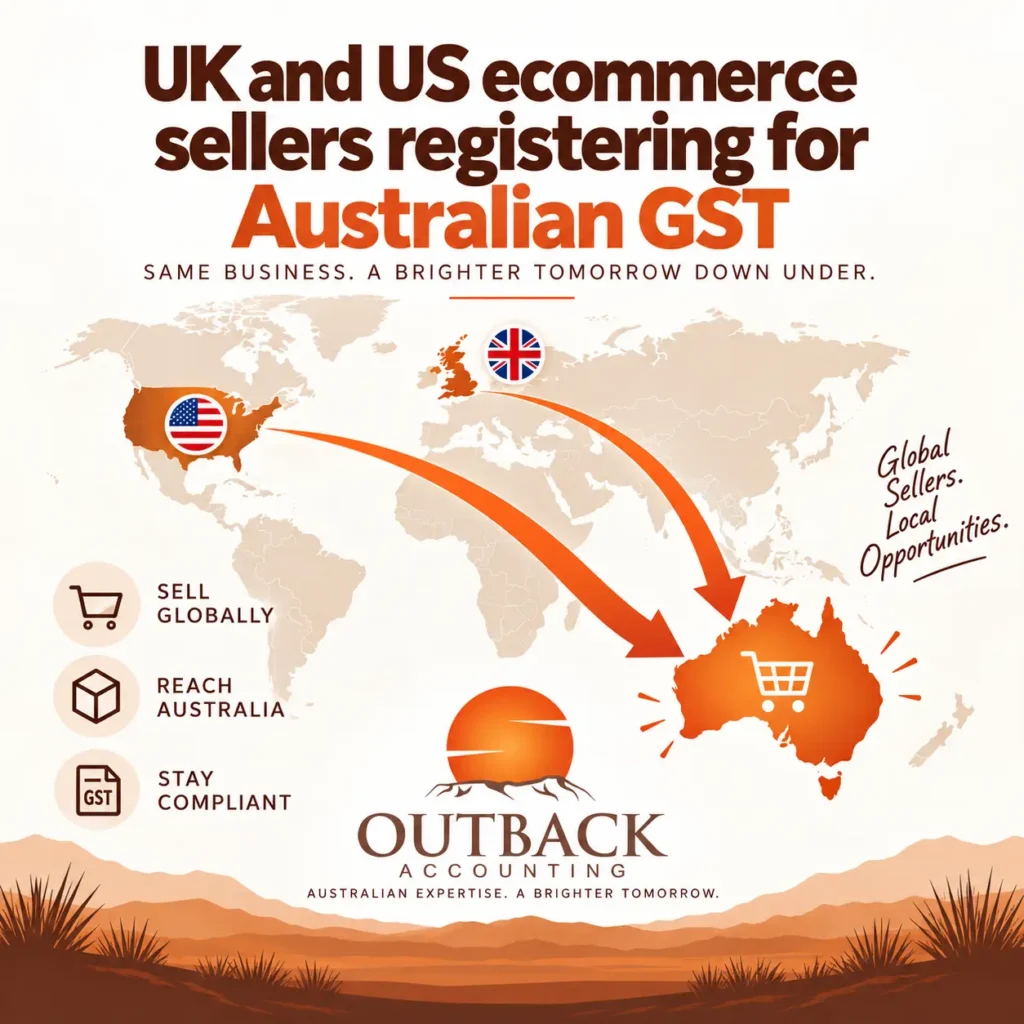
If you’re a UK or US ecommerce business selling into Australia, there’s a point where the ATO stops being a distant abstract concept and becomes a real compliance obligation. That point is the $75,000 AUD turnover threshold and once you cross it, GST registration is required, whether you have an Australian presence or not.
The good news is that the ATO has built a genuinely simple registration pathway for overseas businesses. The less-good news is that most overseas sellers don’t know it exists, don’t know when they need to use it, and don’t know what happens after they register.
This guide covers GST registration for overseas ecommerce sellers targeting Australia when you need to register, the two registration options available, how to actually go through the process, and the ongoing obligations that come after.
When overseas ecommerce sellers must register for Australian GST
The trigger for GST registration in Australia is the same for overseas businesses as it is for domestic ones. Once your annual GST turnover from Australian sales reaches or is expected to reach $75,000 AUD, registration is required.
“GST turnover” here means the total value of your taxable Australian sales, measured on a rolling 12-month basis. That includes both looking back at the last 12 months and looking forward at the next 12 months. If either projection puts you over $75,000 AUD, registration becomes mandatory.
For most overseas sellers, the specific triggers are:
- Physical goods shipped from overseas to Australian consumers where the sale value is under $1,000 AUD per item (the low-value imported goods regime)
- Digital products or services sold to Australian consumers from overseas (streaming services, downloads, SaaS, ebooks, courses, professional services)
- Any goods held in Australia at the time of sale for example, inventory sitting in an Amazon FBA fulfilment centre in Sydney
Goods over $1,000 AUD per unit are generally handled through customs at the border and don’t require the overseas seller to register for GST. The importer of record deals with the GST at that point.
The two registration pathways: simplified vs standard
Overseas sellers have two options when it comes to GST registration in Australia. The right one depends on your situation.
Simplified GST registration was introduced specifically for overseas suppliers with no Australian presence. It’s designed to make compliance realistic for businesses that don’t have an ABN, don’t have an Australian bank account, and don’t want to deal with the full weight of Australian tax administration.
Standard GST registration is the traditional pathway. It requires an Australian Business Number (ABN), lets you claim input tax credits on Australian business expenses, and integrates you into the full Australian tax system.
The differences that matter:
| Feature | Simplified GST | Standard GST |
|---|---|---|
| ABN required | No | Yes |
| Australian bank account required | No | Yes |
| Input tax credits claimable | No | Yes |
| Lodgement frequency | Quarterly | Monthly, quarterly or annual |
| Registration process | Fully online, no ID verification | Full ABN application with proof of identity |
| Best for | Overseas sellers with no AU presence | Overseas sellers with AU inventory, offices, staff, or wanting to claim credits |
For a UK or US ecommerce business selling into Australia via Shopify or their own website, with no Australian inventory or offices, simplified GST is usually the right choice. For a seller using Amazon FBA in Australia, holding stock in an Australian warehouse, or planning to establish an Australian entity, standard GST is generally the better path.
How simplified GST registration works
The simplified GST system has been genuinely well-designed. If your business qualifies, the process takes an hour or two rather than weeks.
The steps:
- Go to the ATO’s Simplified GST registration portal (available through the ATO website). No account setup or identity verification required upfront.
- Provide your business details legal name, business address, contact person, country of tax residence, and your local tax identification number (VAT number for UK businesses, EIN for US businesses).
- Confirm the type of Australian sales you’re making digital products, digital services, or low-value imported goods.
- Specify your intended reporting currency (you can lodge and pay GST in a range of major currencies, including USD, GBP, EUR, or AUD).
- Nominate a contact for ATO correspondence. This doesn’t need to be an Australian resident.
- Receive your ARN (ATO Reference Number) the equivalent of an ABN for simplified GST purposes.
Once registered, you charge 10% GST on your taxable Australian sales and lodge a quarterly GST return through the online portal. Payments can be made from an overseas bank account in your nominated currency. No BAS in the traditional Australian sense the reporting is simpler.
How standard GST registration works for overseas sellers
If you need the full ABN pathway because you have Australian inventory, want to claim input tax credits, or plan to establish a permanent Australian presence the process is more involved.
You’ll need to apply for an ABN as a non-resident entity. This requires proof of identity for the business and its owners/directors, and evidence of a genuine connection to Australia (Australian customers, inventory in Australia, an Australian intermediary, or a similar factor).
Once the ABN is issued, GST registration follows through the same portal used by Australian businesses. You’ll be assigned a lodgement frequency (typically quarterly for smaller businesses, monthly for larger ones), lodge full Business Activity Statements, and be able to claim GST credits on eligible Australian business expenses.
The full ABN pathway takes longer to set up several weeks in most cases and usually benefits from having an Australian tax agent or accountant handle it. For UK and US sellers new to the Australian market, this is where our ecommerce accounting services for overseas sellers come in.
GST on low-value imported goods (LVIG) what changed in 2018
Before 2018, goods valued under $1,000 AUD sold to Australian consumers from overseas were GST-free at the border. The 2018 rule change closed that gap.
Since 1 July 2018, overseas sellers, marketplace operators (electronic distribution platforms) and re-deliverers who sell low-value imported goods to Australian consumers are required to register for GST once they cross the $75,000 AUD threshold. GST is collected at the point of sale rather than at the border for these goods.
This is why UK Etsy sellers with meaningful Australian sales, US Shopify stores shipping physical products to Australian customers, and Chinese direct-to-consumer sellers on platforms like AliExpress are all captured by Australian GST rules if their turnover crosses the threshold.
For sellers under the threshold, no GST registration is required but keep an eye on the rolling 12-month projection. Growth can put you over the line quickly.
When Amazon, eBay or Etsy handles GST for you
Under the electronic distribution platform (EDP) rules, marketplaces like Amazon Australia, eBay Australia, and Etsy are required to collect and remit GST on your behalf for eligible sales to Australian consumers.
If you’re an overseas seller selling exclusively through these platforms into Australia, the platform handles GST for you. You don’t need to register separately for GST just because you’re selling on Amazon AU. The platform is the deemed supplier for GST purposes.
However and this is where it gets nuanced — if you also sell through your own website (Shopify, WooCommerce, direct checkout) alongside marketplace sales, the platform-collected GST doesn’t cover your direct sales. Your direct-to-consumer turnover still counts toward the $75,000 threshold, and if you cross it, you need to register for GST on those direct sales.
Sellers running multi-channel operations (marketplace + own store) often assume the platform’s GST collection covers everything. It doesn’t. The direct channel needs its own compliance handling.
Common mistakes overseas sellers make
Assuming Australian rules don’t apply because you’re based overseas. The $75,000 threshold applies to overseas sellers as much as domestic ones, and enforcement has become more consistent since the 2018 reforms.
Assuming marketplace-collected GST covers everything. Amazon and eBay handling GST on marketplace sales doesn’t extend to your direct sales through Shopify or your own website.
Missing the AUD conversion when tracking the threshold. If you sell in USD, EUR or GBP, you need to convert to AUD at prevailing rates to know whether you’re above the $75,000 line. Sellers using inflated conversion rates or ignoring FX movement often cross the threshold months before they realise.
Registering for standard GST when simplified would have worked. Standard GST creates ongoing compliance overhead most overseas sellers don’t need. Simplified is designed for exactly this situation use it if you qualify.
Ignoring GST on digital products. Digital services and downloadable products sold to Australian consumers are absolutely captured by Australian GST rules. This includes SaaS subscriptions, online courses, ebooks, streaming services, and professional services delivered digitally.
Not tracking the threshold in real time. Overseas sellers who only check their Australian turnover once a year often find they’ve been over the threshold for six months without knowing. The threshold is a rolling 12-month figure it needs monthly monitoring, not annual.
Missing the tax-free export rules from the other direction. If you’re an Australian-based seller reading this by mistake, sales of physical goods exported to overseas customers are generally GST-free exports, but they still need to be reported on your BAS as GST-free supplies.
Ongoing obligations after registration
Registration is the start, not the end. Once you’re registered for Australian GST, you have ongoing obligations:
Lodge GST returns on time. For simplified GST, this is quarterly through the online portal. For standard GST, it’s the standard BAS cycle (monthly or quarterly depending on your turnover).
Charge GST correctly at 10% on taxable Australian sales. This means your checkout, invoices, and receipts all need to show GST as a separate line item where applicable.
Remit the GST collected to the ATO by the due date. Late payment attracts general interest charge (GIC) and possible penalties.
Keep records for five years. The ATO can review your GST compliance at any time within the review period. Transaction records, supporting documents, and evidence of the $75,000 threshold calculation all need to be retained.
Notify the ATO if your circumstances change. Changes to your business structure, address, contact details, or if you cease making taxable Australian sales all need to be reported.
When overseas sellers need specialist help
For a UK or US ecommerce business selling directly into Australia at moderate volumes, the simplified GST pathway is manageable with a competent bookkeeper. Once complexity increases, having an Australian ecommerce accountant involved usually saves money and reduces compliance risk.
Bringing in a specialist is worth it when:
- You’re planning to hold inventory in Australia (Amazon FBA AU, third-party fulfilment)
- You sell across multiple channels including your own website and marketplaces
- You want to claim input tax credits on Australian business expenses (requires standard GST)
- You’re planning to establish an Australian entity or subsidiary
- Your Australian sales have crossed the threshold and you’re unsure which registration pathway applies
- You need help setting up Xero (or your accounting system) for AUD reporting and BAS lodgement
Our ecommerce accounting services for overseas sellers work with UK and US ecommerce businesses selling into Australia. We handle GST registration (simplified or standard), Xero setup for multi-currency and BAS-ready reporting, ongoing quarterly lodgements, and the strategic decisions around when to establish an Australian entity as sales grow.
Frequently asked questions
Do overseas ecommerce sellers need to register for Australian GST? Yes, once their Australian sales turnover reaches $75,000 AUD on a rolling 12-month basis. Below that threshold, registration isn’t required — but you should monitor closely because growth can put you over the line faster than you expect. UK, US and other overseas sellers are captured by Australian GST rules the same way domestic sellers are.
What’s the difference between simplified GST and standard GST for overseas sellers? Simplified GST is designed specifically for overseas sellers with no Australian presence. No ABN, no Australian bank account, quarterly online lodgement, and you can pay in your preferred currency. Standard GST requires an ABN and full BAS lodgement, but lets you claim input tax credits on Australian business expenses. Most UK/US sellers selling directly into Australia use simplified GST.
Can I sell into Australia without registering for GST? Yes, if your Australian sales stay below the $75,000 AUD threshold on a rolling 12-month basis. Once you cross the threshold, registration is required within 21 days. Failing to register when required creates a GST liability plus potential penalties. Monitor your Australian sales in AUD monthly if you’re anywhere near the threshold.
Does Amazon or eBay collect GST on my behalf? Yes, for sales made through their platforms to Australian consumers. Under the electronic distribution platform rules, Amazon Australia, eBay Australia and Etsy collect and remit GST on eligible marketplace sales. However, this only covers marketplace sales if you also sell directly through your own website, those sales aren’t covered and count toward your own GST registration threshold.
How long does simplified GST registration take? The registration itself can be completed online in an hour or two. Once submitted, most applications are processed within a few business days. Compared to full ABN and standard GST registration (which can take weeks), simplified GST is designed to be quick.
Do I need an Australian bank account to register for GST? Not for simplified GST. You can register, lodge returns, and pay GST in a range of major currencies (USD, GBP, EUR, AUD) from an overseas bank account. Standard GST does typically require an Australian bank account and full ABN.
Are digital products sold from overseas to Australian consumers subject to GST? Yes. Digital services and products (SaaS, online courses, ebooks, streaming, professional services delivered digitally) sold to Australian consumers are captured by Australian GST rules if the seller’s Australian turnover crosses the $75,000 threshold. This applies regardless of where the seller is based.
Can I claim GST credits as an overseas seller? Only under standard GST registration, which requires an ABN. Under simplified GST, you charge GST on your Australian sales but can’t claim input tax credits on any Australian expenses. If claiming credits matters to your business (e.g. you’re paying Australian warehousing fees, marketing costs, or professional services), standard GST is the better pathway.
Get your Australian GST registration sorted
Selling into Australia from the UK, US or anywhere else is entirely workable — the ATO has built a genuinely simple pathway for overseas sellers, and thousands of international ecommerce businesses use it every year without issue.
The complexity isn’t in the registration itself. It’s in knowing which pathway suits your business, understanding what your ongoing obligations look like, and setting up your accounting so the ongoing lodgements don’t become a monthly headache.
Our ecommerce accounting services for overseas sellers handle Australian GST registration and ongoing compliance for UK, US and international ecommerce businesses. Get in touch with our Sydney team to talk about setting up Australian GST properly for your business.