
Most Australian ecommerce sellers don’t start with a specialist accountant. They start with the family accountant, the one a friend recommended, or the bookkeeper who’s good enough for a service business. That works until it doesn’t.
The point where it stops working isn’t dramatic. It’s a slow drift. Your books stop matching Shopify. Your BAS keeps needing adjustments. Your accountant can’t tell you what your gross margin actually is because they’re not sure which fees to include. You find yourself explaining Amazon FBA settlement reports to someone whose job is supposed to be understanding them for you.
If any of that sounds familiar, this guide covers when to hire a specialist ecommerce accountant in Australia the specific signs, the hidden cost of waiting, and what makes the difference between a general accountant and someone who genuinely gets how online businesses work.
Why ecommerce accounting is actually different
Most accountants are trained for service businesses or traditional product businesses sell a thing, receive a payment, book the revenue, lodge the BAS. Ecommerce is nothing like that.
Every sale involves a platform (Shopify, Amazon, eBay, Etsy, WooCommerce), a payment gateway (Stripe, PayPal, Afterpay), and a settlement cycle that bundles sales, fees, refunds, and adjustments into one net payout. The deposit landing in the bank is not the revenue. The sales report from the platform isn’t the bank activity. The GST treatment depends on the marketplace, the customer location, and whether digital or physical goods are involved.
A generalist accountant can file a tax return for an ecommerce business. What they usually can’t do is set up the chart of accounts to reflect ecommerce reality, reconcile platform payouts correctly, apply the right GST treatment to marketplace facilitator rules, or spot the FX gaps on USD settlements. That’s not a criticism it’s just a different skill set.
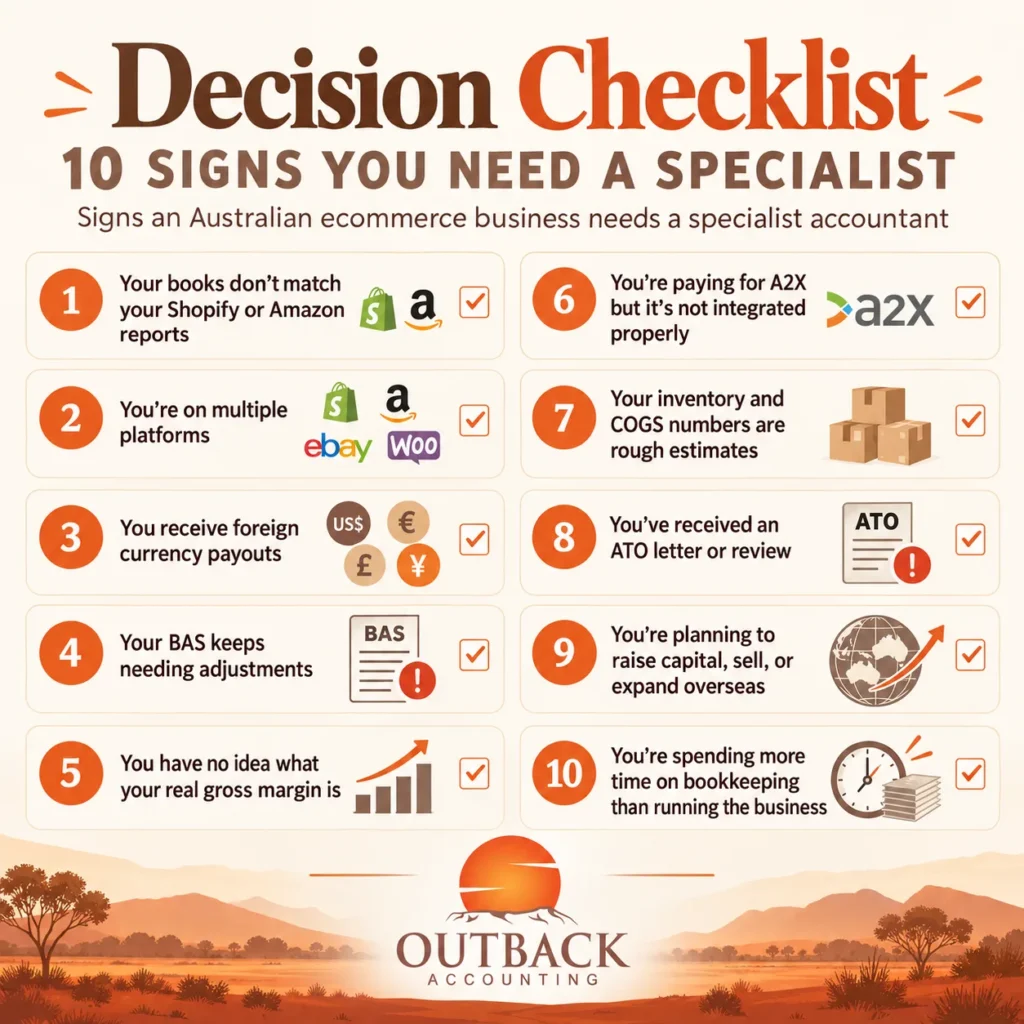
10 signs it’s time to hire a specialist
1. Your books don’t match your Shopify or Amazon reports
Your platform says you did $45,000 in gross sales. Your P&L in Xero shows $38,000 in revenue. If you can’t reconcile the gap in under 5 minutes, your setup is wrong and someone who works in ecommerce accounting every day will fix it in an hour.
2. You’re on multiple platforms
Running Shopify alongside Amazon FBA, or any combination of Etsy, eBay, and your own store, means every platform has its own settlement cycle, fee structure, and reporting. A generalist juggling four different workflows will miss things. A specialist already has a system.
3. You receive foreign currency payouts
If you sell on Amazon US or Amazon UK, or have Stripe accepting international cards, you’re dealing with USD/GBP/EUR payouts that convert to AUD at variable rates. FX gains and losses are real income or deductions under Australian tax law — and most generalists ignore them.
4. Your BAS keeps needing adjustments
If your accountant has to amend your BAS more than once a year because the GST figures don’t tie out, the problem is almost always ecommerce-specific: marketplace facilitator rules, platform fee GST credits missed, or GST-free exports reported as taxable sales.
5. You have no idea what your real gross margin is
A good ecommerce accountant can tell you your gross margin by product, by platform, and by period. If yours can only tell you “overall revenue minus cost of goods sold,” that’s not enough for pricing decisions, discounting strategy, or deciding which product lines to drop.
6. You’re paying for A2X but it’s not integrated properly
A2X is the industry standard for ecommerce accounting integration — but it only works if someone sets it up with the correct chart of accounts, GST mapping, and clearing accounts. If you’re paying for A2X and your bank reconciliation still doesn’t match, the integration isn’t done right.
7. Your inventory and COGS numbers are rough estimates
If your closing inventory figure at year end is a guess rather than a count, your COGS is wrong and so is your gross margin, your tax position, and your P&L. Specialist ecommerce accountants set up proper inventory tracking from the start.
8. You’ve received an ATO letter or review
ATO letters about GST discrepancies, super guarantee shortfalls, or BAS corrections are stressful. A specialist who understands ecommerce reconciliation can usually resolve them within a few days. A generalist unfamiliar with the platforms will take weeks and still get it partially wrong.
9. You’re planning to raise capital, sell, or expand overseas
Investor-ready financials require clean, platform-reconciled numbers that stand up to due diligence. Selling the business requires financial statements that show real profitability. Expanding into new marketplaces requires understanding GST, VAT, or sales tax implications in those jurisdictions. All of this needs ecommerce experience.
10. You’re spending more time on bookkeeping than running the business
The sign most sellers ignore the longest. If you’re pulling settlement reports every fortnight, chasing refunds in your accounting software, or reconciling clearing accounts manually on weekends, you’ve outgrown your current setup. A specialist system should run quietly in the background while you focus on the business.
The hidden cost of waiting
The reason specialists exist is that the mistakes a generalist makes on ecommerce accounting compound over time. A few examples we see regularly:
- Missed GST credits on Shopify, Stripe, and Amazon fees — often several thousand dollars a year across a mid-size seller
- Overstated revenue because net payouts were coded as sales — leading to tax paid on money the business never actually earned
- Phantom inventory because FBA reimbursements weren’t tracked — balance sheet shows stock that doesn’t exist
- Incorrect GST treatment on exports — meaning BAS lodgements that may need to be amended going back years
- Overpaid tax from under-claimed deductions because platform fees weren’t properly categorised
Most ecommerce sellers who switch to a specialist report that the cost difference pays for itself in recovered GST credits and correct deductions within the first 6 months — before even considering the time saved and the better decisions enabled by accurate numbers.
What a specialist actually brings
The difference isn’t just experience — it’s the systems and workflows built around ecommerce specifically. A good specialist should have:
- A pre-built chart of accounts template designed for Shopify, Amazon, eBay, Etsy, and WooCommerce sellers
- Experience setting up A2X or Link My Books across different platform combinations
- Understanding of marketplace facilitator GST rules in Australia (and how they differ between Amazon AU, eBay AU, and Etsy)
- Knowledge of multi-currency Xero setup for USD and GBP payouts
- A proven monthly reconciliation workflow that matches to the cent
- Familiarity with the common ATO queries ecommerce businesses receive
- Direct relationships with the platforms and software providers (A2X-certified, Xero Gold Partner, etc)
If an accountant can’t demonstrate most of these when you ask, they’re not a specialist they’re a generalist who takes ecommerce clients.
Common objections (and why they don’t hold up)
“My current accountant is cheaper.” Possibly, but if a specialist recovers $5,000 in missed GST credits and prevents $8,000 in overpaid tax in your first year, the fee difference is more than covered. Cheap accounting on wrong numbers is the most expensive kind.
“We’re too small for a specialist.” Most ecommerce specialists work with businesses doing $200k to $5m in annual sales not just large brands. If you’re reconciling platform payouts, you’re already in specialist territory.
“I don’t want to switch we’ve been with our accountant for years.” You don’t necessarily have to switch for everything. Many businesses keep their existing accountant for the annual tax return and bring in a specialist for ecommerce bookkeeping, A2X setup, and BAS lodgement. Both can work together.
“We’re not sure we’re profitable enough to justify it.” Without specialist accounting, you don’t actually know whether you’re profitable. That’s the first thing a specialist review usually clarifies — and from there, every decision gets better.
When specialist help isn’t necessary (yet)
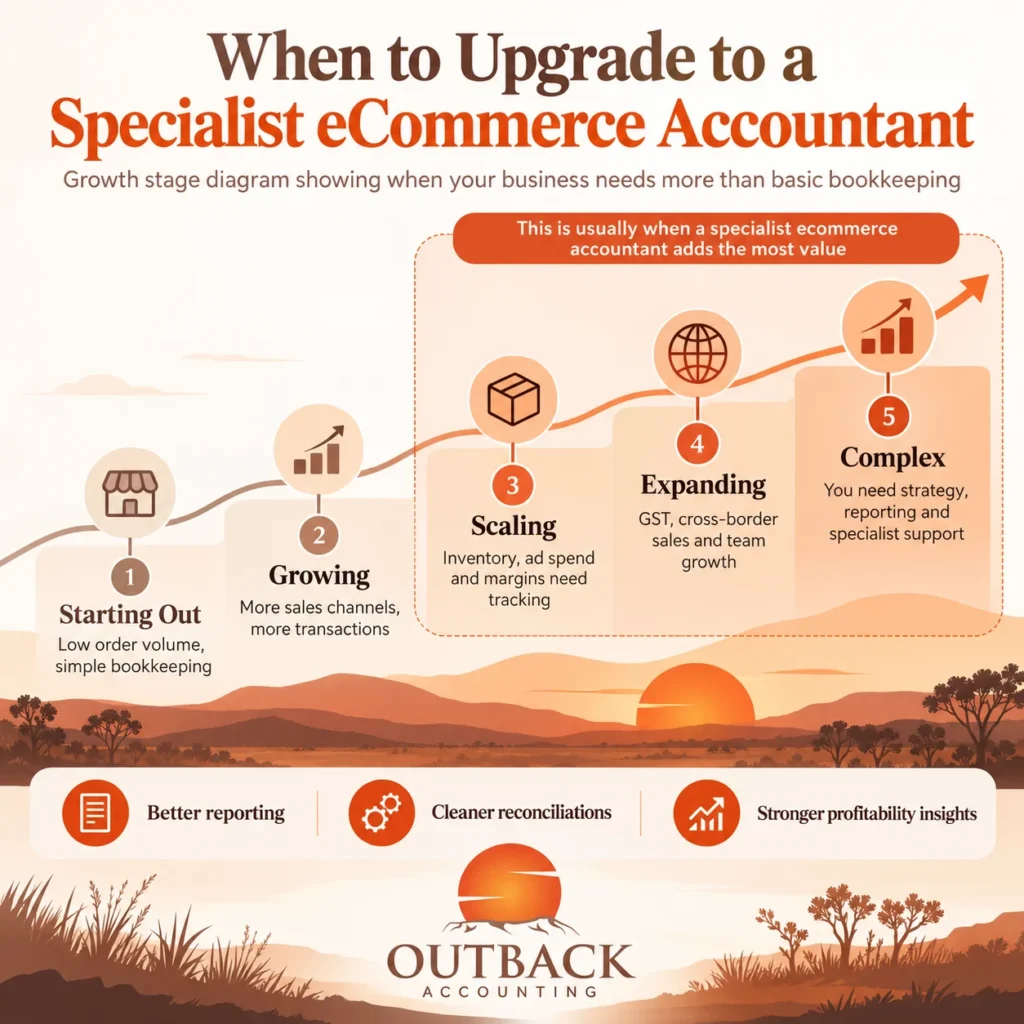
A specialist isn’t essential for every seller. If you’re:
- Running a very low-volume store (under $50k annual turnover)
- On a single platform with no international sales
- Not registered for GST
- Comfortable with your own bookkeeping and reconciliation then your current setup is probably fine. The point to reassess is when any one of those situations changes growth past the GST threshold, adding a second platform, selling internationally, or needing better data to make decisions.
Choosing the right specialist
If you’re ready to engage one, three questions worth asking before you commit:
- Which platforms do you work with regularly? You want someone who’s actively working across Shopify, Amazon, and other platforms every week not just once a quarter.
- Do you use A2X (or equivalent) as standard? The answer should be yes. If they’re reconciling Amazon or Shopify manually at scale, their process is inefficient.
- Can you show me what my monthly reporting will look like? A specialist should be able to show you a sample management reporting pack not just promise one.
Our team at Outback Accounting provides specialist ecommerce accounting services built around how Australian online sellers actually operate. A2X-certified, Xero Gold Partner, and working across Shopify, Amazon FBA, eBay, Etsy, and WooCommerce every day.
Frequently asked questions
When should I switch from a generalist accountant to a specialist? The clearest trigger is when your books stop matching your platform reports — if you can’t reconcile Shopify, Amazon, or eBay sales to your Xero file in a few minutes, your current setup isn’t working for ecommerce. Other common triggers include multiple platforms, foreign currency sales, BAS corrections needed repeatedly, or spending too much time on bookkeeping.
How much does a specialist ecommerce accountant cost in Australia? Fees vary based on complexity, but most specialist firms work on fixed monthly packages ranging from around $500 to $2,500 per month depending on sales volume, number of platforms, and whether you need inventory, multi-currency, or fractional CFO services. The cost is usually offset by recovered GST credits, prevented tax errors, and the time you get back.
Can I keep my current accountant for tax and use a specialist for ecommerce? Yes many Australian ecommerce businesses do exactly this. Your existing accountant handles the annual income tax return. The specialist handles ongoing bookkeeping, A2X setup, platform reconciliation, and BAS lodgement. The specialist usually hands clean financials to the tax accountant at year end.
What’s the difference between an ecommerce bookkeeper and an ecommerce accountant? A bookkeeper handles day-to-day transaction recording, reconciliation, and BAS preparation. An accountant handles tax planning, financial strategy, business structuring, and year-end reporting. Many ecommerce specialists do both but the two functions are distinct and often require different skill levels.
How quickly can a specialist get my ecommerce accounting sorted? For a straightforward switch — single platform, clean existing records, Xero already in use — a specialist can typically set up A2X, map your chart of accounts, and have everything reconciled within 2–4 weeks. For businesses with messy historical data, multiple platforms, or multi-currency complexity, the setup can take longer but still usually completes within 2–3 months.
What should I bring to an initial meeting with an ecommerce accountant? Access to your Shopify (or Amazon, eBay, Etsy) seller dashboard, your Xero file, your last two BAS lodgements, a recent bank statement, and a rough overview of your annual sales. From that, a specialist can usually identify the main issues within a 30–45 minute conversation.
Will switching to a specialist disrupt my business? A proper handover takes a few weeks but shouldn’t disrupt day-to-day operations. The specialist will typically run alongside your existing setup for a cycle or two to ensure the new system reconciles correctly before fully transitioning you over.
Get a specialist review of your current setup
If you’re not sure whether your current accounting setup is working for your ecommerce business, the fastest way to find out is a short review of your books by someone who works in this space every day.
Outback Accounting’s specialist ecommerce accounting services cover Shopify, Amazon FBA, eBay, Etsy, and WooCommerce with A2X integration, Xero setup, GST compliance, and monthly reporting built for how ecommerce actually works.
Get in touch with our Sydney team for a no-obligation conversation about where your setup is now and where it should be.
Disclaimer: This article is for general information purposes only and does not constitute financial, tax, or legal advice. For advice specific to your circumstances, please reach out to your accountant.