
Etsy accounting for Australian sellers: GST, listing fees and profit tracking
Etsy is one of the few platforms where the accounting can feel harder than the business itself. You’re a maker, not a bookkeeper. You’ve priced your products based on materials plus something for your time. Then Etsy takes a slice through fees you didn’t quite budget for, in a currency that isn’t Australian dollars, and suddenly you’re not sure what you actually made this quarter.
This guide is for Sydney-based and Australian Etsy sellers who want to understand what’s happening with their money. GST, fees, the USD conversion, and profit tracking that actually reflects reality.
When Etsy selling becomes a business (not a hobby)
The ATO doesn’t care whether you call yourself a maker, a crafter, or a small business owner. What they care about is whether your Etsy activity is commercial in nature.
Selling occasionally, giving most of your work away, and not making a profit is a hobby. Regularly making and selling products, buying materials specifically to sell, pricing with a margin in mind, and running your shop with the intention of making money is a business. Most Etsy sellers with steady activity are on the business side of that line whether they think of themselves that way or not.
Once your Etsy activity crosses into business territory, three things change. Your income is assessable for income tax. Your expenses (materials, listing fees, transaction fees, packaging, shipping supplies) become deductible. And if your annual turnover crosses the GST registration threshold, you have to register for GST with the ATO.
The line between hobby and business trips up a lot of Etsy sellers because the platform makes it easy to start selling before you’ve thought about tax at all. If you’re not sure which side you’re on, worth clarifying with a Sydney accountant before the ATO starts sending letters.
Etsy’s fee structure and how to record it
Etsy charges sellers across several categories. All of them are business expenses, but only if they’re recorded correctly.
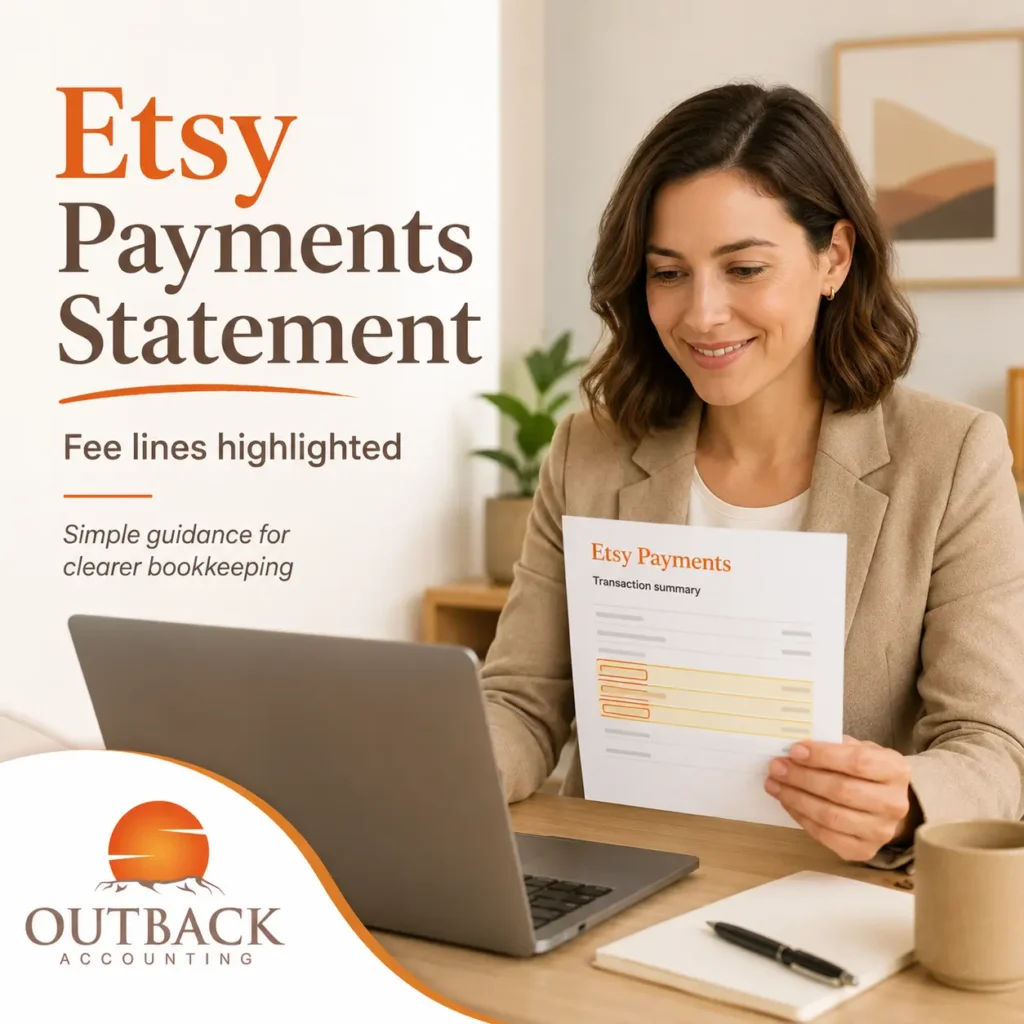
The listing fee is USD $0.20 per item listed, charged when you create a new listing or a listing is renewed after four months or a sale. Not a huge number per item, but for shops with a large catalogue it adds up fast.
The transaction fee is the main one. Etsy charges 6.5% of the total sale price, including shipping and any gift wrap charges, on every completed sale. This is your primary Etsy expense and needs to sit in cost of sale, not general expenses.
Payment processing through Etsy Payments is separate again. 3% plus $0.25 AUD per transaction in Australia. Often confused with the transaction fee, but they’re distinct charges.
Offsite Ads is where a lot of sellers get caught out. If Etsy runs an ad for your listing on Google or Facebook and a buyer clicks it and purchases within 30 days, Etsy charges 12% (if your annual sales exceed USD $10,000) or 15% (if under). This is advertising, not a platform fee. Different account, different analysis.
There’s also a currency conversion fee of 2.5% on any transactions Etsy converts between currencies. It doesn’t show as a line item most sellers pay attention to, but it’s baked into your net deposits. And Etsy has recently added small regulatory operating fees on sales in certain regions to cover compliance costs.
Under Etsy Payments, all of these come out before your money is deposited. The number that lands in your bank account is not your revenue. Recording it as income means every fee above disappears from your books — and your profit figure is wrong.
GST on Etsy sales in Australia
Etsy operates as an electronic distribution platform under Australian tax law. For most sales to Australian customers, Etsy collects and remits GST on behalf of sellers. You don’t charge GST to the buyer separately.
That doesn’t make GST irrelevant if you’re registered though.
Etsy charges GST on its own fees to Australian sellers. If you’re GST-registered, that GST is claimable as an input tax credit on your BAS. Sellers who never look at the fee breakdown miss those credits every single quarter.
The GST registration threshold is based on gross turnover, meaning total sales before Etsy’s fees, not the net amount you receive after they take their cut. Once that gross figure crosses $75,000 in a rolling 12-month period, registration is required.
Physical goods shipped to overseas customers are generally GST-free exports. They still need to appear on your BAS as GST-free supplies. Digital products (printables, patterns, design files) have their own set of rules that differ from physical goods, and there are edge cases with digital sales to Australian consumers worth checking with an accountant if you sell them.
USD payouts and foreign exchange for Australian Etsy sellers
Etsy operates in USD by default. Even if your prices display in AUD to buyers, Etsy converts everything through its own internal FX rates, and your Etsy Payments account typically holds a mix of currencies depending on where your buyers are based.
When Etsy deposits into your Australian bank account, the AUD amount you receive is a conversion — at Etsy’s exchange rate on the day, which is not the same as the market rate. The difference is embedded in the conversion fee.
Every sale should be recorded at the AUD value on the date of sale, not the date the funds arrive. The difference between the AUD value at sale and the AUD value at payout is a foreign exchange gain or loss, and both are relevant under Australian tax law. Gains are assessable income, losses are deductible.
For most small Etsy sellers this is a small item at year end. For higher-volume Sydney and Australian shops the FX movements can add up to real numbers. Xero handles multi-currency accounting properly if it’s set up correctly, recording sales in the original currency and applying exchange rates to convert to AUD automatically.
Tracking your COGS (and why it matters more for makers)
For handmade Etsy sellers, cost of goods sold isn’t as clean as buying and reselling. You’re making things from a mix of raw materials, some of which get used across multiple products, some of which have leftover value at the end of a batch.
Your COGS should include the raw materials that go into each product (yarn, fabric, wood, beads, ink, paper, whatever your medium is), packaging materials specific to each product, shipping supplies like boxes and mailers and labels, and any consumables directly attached to making the product such as thread, adhesives, and finishing supplies. If you’re reselling or dropshipping through Etsy rather than making your own, the wholesale cost of the product itself is your COGS.
What often gets confused with COGS but isn’t:
- Studio rent (an operating expense, not COGS)
- Equipment purchases (usually depreciable assets, not COGS)
- Your own labour (unless you’re paying yourself formally through payroll)
- General shop expenses like Etsy fees (separate line items, not COGS)
Getting COGS right matters because it drives your gross margin. Without accurate COGS, you have no idea whether your pricing actually covers what a product costs to make, let alone whether there’s enough left over to justify the time.
Common Etsy accounting mistakes Australian sellers make
Coding the Etsy Payments deposit as revenue is the most common mistake by a significant margin. Revenue is gross sales. The deposit is what’s left after Etsy’s fees.
Not claiming GST credits on Etsy fees is another one. If you’re GST-registered, the GST charged by Etsy on its own fees is claimable on your BAS. Most sellers doing manual reconciliation never see it, and it adds up quarter after quarter.
Undervaluing materials in COGS. Guessing at materials costs, or only counting the big items and ignoring the small ones, means your gross margin figure is wrong. Individually cheap materials add up to noticeable numbers in aggregate over a year.
Ignoring FX entirely. For sellers moving real volume through USD payouts, ignoring FX conversions creates a gap between what you actually earned in AUD and what your books show.
Running Etsy shop income through a personal bank account. Makes record keeping harder, creates GST complications, and is one of the fastest ways to draw ATO attention if your affairs are ever reviewed.
Treating Offsite Ads as a normal platform fee. It’s advertising spend. Coding it into the same account as your regular Etsy fees makes it impossible to evaluate whether the ads are actually generating a return.
Connecting Etsy with Xero
Etsy doesn’t have a native Xero integration, but there are workable options.
A2X supports Etsy and works the same way it does for Amazon and Shopify. It pulls transaction data automatically, categorises sales, fees, refunds, and adjustments, and posts clean journal entries to Xero on a settlement basis. Bank reconciliation matches to the cent, fees are captured in the right accounts, and GST is applied correctly.
Manual CSV imports from Etsy’s downloadable reports are a free option, but time-consuming and prone to error once you’re moving any real volume.
Bank feed reconciliation alone (which is what a lot of Etsy sellers default to) doesn’t work well. The bank feed only shows the net payout. All the fee detail is missing, and there’s no way to reconstruct it later without going back to Etsy’s reports.
For any Etsy shop generating regular sales, an A2X integration typically pays for itself in accountant time saved and mistakes avoided.
Choosing an Etsy accountant in Sydney
Etsy has its own quirks: the fee structure, the USD conversion, the mix of handmade and digital products, the GST rules for electronic distribution platforms. A generalist Sydney accountant will handle your tax return, but they may not be across any of the Etsy-specific things that affect your books month to month.
When you’re choosing an accountant, ask directly whether they’ve worked with Etsy sellers before, how they handle the reconciliation between Etsy deposits and gross sales, and whether they’re familiar with A2X or another Etsy integration for Xero. Ask about GST on Etsy fees specifically. If the answer is generic, they haven’t dealt with Etsy sellers before.
For handmade shops, ask whether they can help set up COGS tracking properly for a made-to-order or small-batch business. Standard product-based COGS doesn’t quite fit how makers actually operate.
Outback Accounting is based in Sydney and works with Etsy sellers across NSW and nationally. Our Etsy accounting specialists handle A2X and Xero setup, monthly reconciliations, BAS lodgement, and end-of-year tax returns — built around how handmade and creative businesses actually operate.
Frequently asked questions
Do I have to declare Etsy income on my Australian tax return? If your Etsy activity is commercial, yes. Regular sales, materials bought to make products for sale, and a profit motive are what the ATO looks at. Occasional hobby-level sales generally aren’t taxable, but most steady Etsy shops are on the business side of that line.
Does Etsy collect GST for me in Australia? For most Australian customer sales, yes. Etsy operates as an electronic distribution platform and collects and remits GST on your behalf. But it also charges GST on its own fees to Australian sellers, and if you’re GST-registered you can claim those amounts back as input tax credits on your BAS.
What’s my income as an Etsy seller — gross sales or the payout? Gross sales. The payout is net of listing fees, transaction fees, payment processing, and any Offsite Ads charges. Recording the deposit as income means those fees never appear as expenses in your books.
When do I need to register for GST as an Etsy seller? Once your gross Etsy turnover (total sales before Etsy’s fees) exceeds $75,000 in any rolling 12-month period. The threshold is based on gross turnover, not the net deposit amounts.
How do I track cost of goods sold for handmade Etsy products? Add up the materials in each product plus packaging and shipping supplies. Include everything consumable that goes into making and posting the item. Keep receipts for every material purchase — the ATO can and does ask for COGS evidence during a review, and lost receipts usually mean lost deductions.
Can I connect Etsy to Xero? Not natively. A2X supports Etsy-to-Xero integration and is the most reliable option. It automatically pulls transaction data, categorises everything, and posts journal entries so your books reflect what actually happened on each settlement.
Are Etsy listing fees tax-deductible? Yes. Listing fees, transaction fees, payment processing, Offsite Ads, and currency conversion fees are all deductible business expenses. If you’re GST-registered, the GST charged on those fees is claimable as an input tax credit on your BAS.
Do you offer Etsy accounting services in Sydney? Yes. Outback Accounting is a Sydney-based ecommerce accounting firm that works with Etsy sellers in Sydney, across NSW, and nationally throughout Australia. We handle Xero setup, A2X integration, GST compliance, BAS lodgement, and annual tax returns for handmade businesses, digital product sellers, and Etsy resellers.
Get your Etsy books working properly
If your Etsy accounting is patched together from spreadsheets, bank feeds, and guesswork, it’s probably not telling you what you think it is. Sellers who get this right have a proper picture of what’s profitable, what their real margin looks like after fees, and what the tax position is heading into BAS time.
Outback Accounting’s Etsy accounting specialists work with Sydney and Australian Etsy sellers to set up A2X, Xero, GST treatment, and COGS tracking properly from day one. Book a chat with our Sydney team to talk about getting your Etsy books sorted.